NMEA interface

NMEA is the National Marine Electronics Association (NMEA). It is a marine electronics trade organization based in the United States that establishes standards for communication between marine electronics devices. There are currently two main standards: NMEA 0183 and NMEA 2000.

What is NMEA?

Digital Yacht NMEA Interfacing products provide smart and cost effective solutions for connecting dedicated marine electronics to the latest consumer devices such as smart phones, laptops and tablets. Both traditional wired and the latest wireless interfaces are available allowing you to easily transfer NMEA data to your mobile device.

Whether you are an iPhone/iPad, Android, PC or Mac user, wireless (or wired) interfacing can now be simply added to your existing navigation system with the addition of one of Digital Yacht’s smart little devices.

We’ve also created NMEA gateways to multiplex the NMEA data or to connect and convert the NMEA data to an Ethernet network or USB device.

NMEA is the National Marine Electronics Association (NMEA) and is a US-based marine electronics trade organisation setting standards of communication between marine electronics. There are currently two main standards: NMEA0183 and NMEA2000.

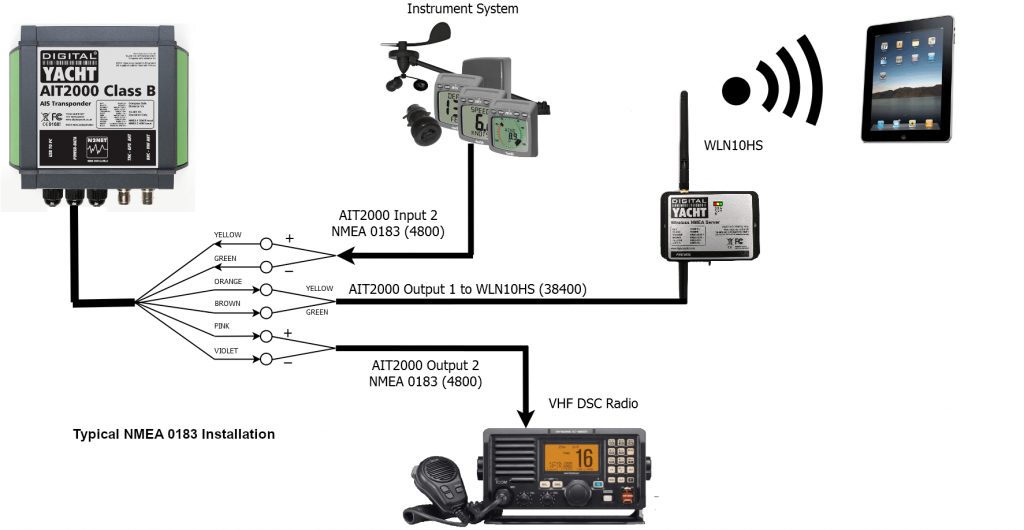
NMEA-0183-Typical-installation

NMEA 0183

NMEA 0183 is the most common standard on board and almost every marine electronic system has an NMEA 0183 input and output. It is important to note that there are two different NMEA data speeds (baud rates) which you may need to configure:

  • 4800 baud is the original NMEA speed and is the most used especially auto-pilots, GPS antenna, VHF radios, marine instruments, etc.
  • 38400 baud is the high speed (HS) data rate used by AIS systems and multiplexers that needed more bandwidth to cope with all the data.
  • In addition, there are other “un-official” data rates, such as 9600 baud used by some non-marine GPS systems and much higher 115,200 and 230,400 rates used by high performance PC software. Knowing the different NMEA speeds is important when connecting and linking different marine electronics products.

Although most of the new marine electronics products use the new NMEA 2000 standard (see below), they often retain at least one NMEA 0183 interface for connection to legacy systems.

NMEA 2000

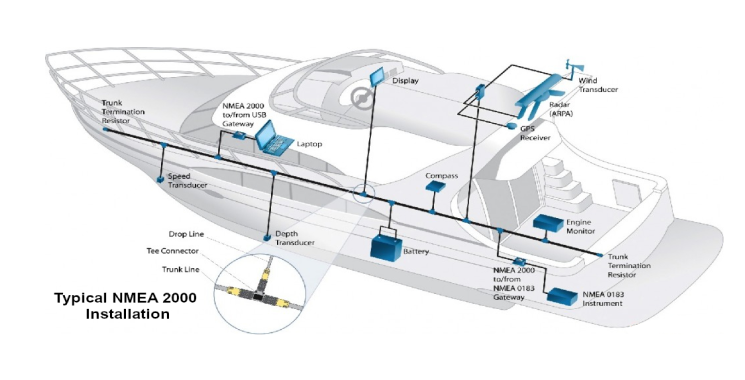
This new standard was developed to accommodate the increasing amount of marine electronics on board modern vessels and the diverse range of data that needed to be communicated on the network. It has been designed to be a very easy, plug-and-play system, where devices and sensors plug in to a network “backbone” (sometimes called “trunk”) that runs the length of the vessel, linking everything together.

The “backbone” can supply both data and power (limited capacity) to any device that connects to it and operates at a much higher 250Kbps data rate than the older NMEA 0183 standard. For good, error-free, data transfer, the “backbone” must be fitted with terminators at each end of the cabling to balance the signal loading and then each device is connected (“spurred off”) using a “T-Piece” connector and drop cable which all use standard Waterproof connectors for maximum reliability and interoperability.

We are regularly asked “what do I need to have an NMEA 2000 network onboard?” This prompted us to create a cost effective and smart NMEA2000 Starter Kit that is ideal for smaller boats but can also be easily expanded in the future.

Typical_NMEA_Installation_onboard

What about accessing NMEA 2000 data remotely?

In today’s connected world, your home, car and smart devices send data to the cloud for monitoring, control and peace of mind. But what about your boat?

Now there’s a solution. NjordLINK+ provides a simple, secure and low-cost way to access your boat’s NMEA 2000 network remotely. Compatible with any NMEA 2000 installation, it combines universal compatibility with strong encryption, privacy and a new generation of cloud-based applications.

NjordLINK+ sends your boat’s NMEA 2000 data to the cloud for real-time monitoring, smart anchoring, historical analysis and more. You can view your boat’s live GPS position together with navigation data such as speed and wind, electrical status, engine information and much more.

We believe NMEA 2000 remote monitoring doesn’t need expensive, custom sensors, as the industry-standard NMEA 2000 networks already provide the main information you need remotely.

For those looking to remotely display and use NMEA 2000 data, we have also released a NjordLink Developer’s Guide that allows web app developers to concentrate on building innovative applications, leaving the challenge of getting NMEA 2000 data off the boat to Digital Yacht.

The importance of NMEA 2000 diagnostics

Maintaining their vessel’s electronic systems is essential for all boat owners. As modern boats become increasingly dependent on NMEA 2000 networks, quickly identifying installation problems, faulty devices or network performance issues is more important than ever. Whether commissioning a new installation, troubleshooting an existing network or carrying out routine maintenance, the right diagnostic tools can save valuable time and prevent costly failures. That’s where Digital Yacht’s range of diagnostics NMEA 2000 tools makes all the difference.


First of all, prevention is better than cure. NET Protect is the world’s first marine cyber security solution for NMEA 2000 network monitoring and protection. From the moment your NMEA 2000 network is installed, NET Protect can test and validate its performance, then continuously monitor it 24/7, detecting potential performance or security issues before they turn into major problems.

If an issue does arise, NAVDoctor transforms your smartphone or tablet into a powerful NMEA 2000 diagnostic and testing tool, making fault-finding fast, simple, and intuitive. A J1939 version of the NavDoctor is also available.

Finally, explore our NMEA 2000 Display App and NMEA 2000 Simulator App to visualise all PGNs and devices on your network, or simulate any NMEA 2000 PGN for testing and analysis.

Discover our products

NMEA to WiFi

All our NMEA to WiFi adaptor products to send the boat data (NMEA) to the tablets, PCs and smartphones.

NMEA interface

All our NMEA interface products such as the NMEA0183-NMEA2000 converter, NMEA to Signal K, NMEA2000 starter kit, etc.

SeaTalk Interfaces

All our SeaTalk1 products such as NMEA to Seatalk converter and GPS with SeaTalk1 output.

USB Interfaces

All our USB interface products such as NMEA to USB, SeaTalk to USB, etc.